
'No one can or will bar India from pursuing its energy goals as it wishes.' 'The US FTA wording may sound more restrictive, but the underlying reality will not undermine India's sovereign energy decisions.'

Indian private sector and State-run refiners continued to receive crude oil from Russian suppliers even after November 21 -- the winding-down date for US sanctions on supplies from leading Russian oil producers imposed in October -- as new intermediaries sprung up in West Asia to sell the oil, according to senior refining sources and ship tracking data.

Speaking to media persons aboard Air India 001, conveying Prime Minister Dr Manmohan Singh to Moscow, Menon said, "This is one relationship without any wrinkles or difficulties." The foreign secretary was reacting to an inquiry whether Russian Foreign Minister Sergei Lavrov's refusal to meet External Affairs Minister Pranab Mukherjee on the latter's visit to Moscow last month.

In the Indo-Pacific's new era -- where perception shapes reality faster than treaties -- the real entrapment is not of China or the United States. It is the test Japan has set for itself -- and whether partners like India, acting as balancers rather than accelerants, can help ensure that the story ends in stability, points out Varun Arya.
India and Russia are expected to give 'privileged' status to their strategic partnership during the upcoming visit of President Dmitry Medvedev as the two sides are likely to break new ground in defence, nuclear and energy sectors, Kremlin sources said on Monday.Medvedev, who is scheduled to arrive in India on Monday night, will hold talks with Prime Minister Manmohan Singh in New Delhi on Tuesday.

MEA spokesperson Randhir Jaiswal said India's energy decisions are guided by national interest.
The Indo-Russian friendship is not susceptible to momentary considerations and political conjunctures, but is based on the concurrence of deep-rooted national interests of the two nations, Russian President Vladimir Putin has said.

Yuki Bhambri and his partner Andre Goransson have advanced to the semifinals of the Indian Wells Masters 1000 tournament after defeating Alexander Erler and Andrea Vavassori.
Yuki Bhambri and his partner Goran Goransson have advanced to the semifinals of the Indian Wells Masters 1000 tournament after defeating Alexander Erler and Andrea Vavassori.

Much, much, much before Rocky Aur Rani Kii Prem Kahaani fussed over What Jhumka, Asha Bhosle trilled in her alluring voice and teased us with tantalising details about the events leading to her precious Jhumka's loss.
Terming technology as an "important factor" in Indo-Russian economic interaction, External Affairs Minister Yashwant Sinha has said he expects a 'technological boom' in bilateral ties.\n\n\n\n
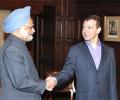
As he prepared to meet President Dmitry Medvedev for the annual summit-level talks, Prime Minister Manmohan Singh has said defence cooperation has been a "very important aspect" in Indo-Russian ties.
Fifteen years after the break up of the Soviet Union and after signing several declarations and partnership pacts, New Delhi and Moscow failed this year to translate their political trust into tangible results in economic interaction and trade.

A Delhi court has granted the National Investigation Agency (NIA) 11-day custody of several foreign nationals accused of training Myanmar-based Ethnic Armed Groups (EAGs) known to support insurgent groups in India.
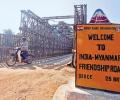
Security agencies in India are investigating a potential conspiracy involving arrested foreigners, including a US mercenary, who allegedly aimed to exploit Indian ethnic groups to undermine national security. The investigation involves data extraction from mobile phones and scrutiny of social media accounts to uncover the full extent of the plot and identify all involved parties.

A nine day Indo-Russian joint air force exercise concluded at the Halwara Air Force Station in Punjab that saw fighter, helicopter and missile crew of the two countries operating together.
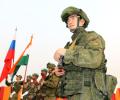
The seventh Indo-Russian joint training exercise INDRA-2015 commenced on Monday at Mahajan field firing range in Bikaner.
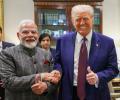
Trump announced that India and the US agreed to a trade deal under which Washington will charge a reduced reciprocal tariff on Delhi, lowering it from 25 per cent to 18 per cent.
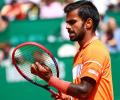
India No. 1 Sumit Nagal exited the Chennai Open ATP Challenger after a three-set defeat to Russia's Petr Bar Biryukov in the second round.
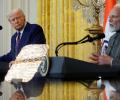
India and the US have entered a new phase in their relationship, marked by greater parity, point out Harsh V Pant and Vivek Mishra.
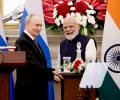
Russia, being bogged down by the Ukraine war and prioritising the requirements of its own armed forces, along with India's consistent diversification policy, will remain a major challenge to the bilateral partnership, note Harsh V Pant and Aleksei Zakharov.

US President Donald Trump greeted India on its 77th Republic Day, highlighting the historic bond between the two democracies amid ongoing trade tensions.
The agreement addresses non-tariff barriers and promotes increased trade in technology products and cooperation between the two countries.

After the US Supreme Court struck down President Donald Trump's global tariffs, Congress leader Rahul Gandhi accused Prime Minister Narendra Modi of being "compromised", saying his "betrayal" in the India-US interim trade deal stood exposed.
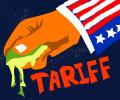
A trade deal makes sense only if it is fair and reciprocal. If the cost is strategic dependence or loss of policy space, waiting is the wiser option, asserts Ajay Srivastava.
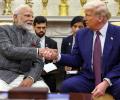
The new US national security strategy signals a retreat from global dominance while reaffirming continuity in India's role in Indo-Pacific security and Quad cooperation, points out former foreign secretary Shyam Saran.

External Affairs Minister S Jaishankar and US Secretary of State Marco Rubio discussed cooperation in trade, critical minerals, nuclear energy, and defence, reaffirming commitment to a free and open Indo-Pacific.
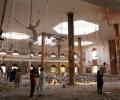
'Some success has been achieved in raising the costs of terrorism for Pakistan.'
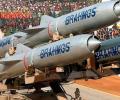
The Navy would be using the missiles for equipping its Veer-class warships while the Indian Air Force would be using them to equip its Russian-origin Su-30 MKI fighter jet fleet, the sources said.
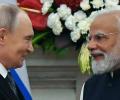
United States representative Sydney Kamlager-Dove while talking about the famous car selfie of Prime Minister Narendra Modi with Russian President Vladimir Putin said that it spoke a thousand words.
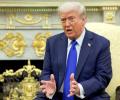
The US Representative criticised the administration's new USD 100,000 fee on H-1B visas, observing that Indians hold 70 per cent of these visas and saying the change directly harms workers who have long supported US innovation across technology, science and medicine.
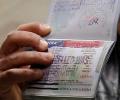
US lawmakers have expressed concerns that policies enacted by the Trump administration, such as the H1B visa fee and tariffs on India, are detrimental to American businesses and threaten the relationship between the United States and India.

The enduring relationship between the two countries have survived the disintegration of the erstwhile USSR in 1991, the end of the Cold War and the regime change in both countries, points out Rup Narayan Das.
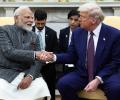
Prime Minister Narendra Modi on Saturday 'deeply' appreciated United States President Donald Trump's 'positive assessment' of the India-US partnership after the American leader hailed the 'special' relationship between the two nations -- remarks seen as an attempt to check the downturn in the ties.
During this period, India will get a feel of the Krivak class missile frigate, which it will acquire in June.
The US is "pretty close" to reaching a "fair trade deal" with India, President Donald Trump has said, adding that he will lower the tariffs imposed on Indian goods at "some point".
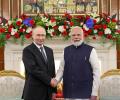
Luckily for us, a Russia that is desperate to stay relevant in an emerging multipolar world finds in India a reliable geostrategic partner. The Russian proximity to India also keeps China from exploiting its economic dominance vis a vis Russia, points out Colonel Anil A Athale (retd).
Admitting that Russia's relations with India have not "developed properly" after the breakup of the Soviet Union, a Russian indologist has called for a proactive approach with focus on cooperation in the energy sector, including nuclear. "Celebrating 2008 as the Year of Russia and 2009 as the Year of India is not enough. These are mere symbolisms. We have to be active, otherwise we will lose," says indologist Felix Yurlov.
India and Russia have agreed to double bilateral trade within 3 years to $10 billion.
 © 2026 Rediff.com - Advertise with us - Disclaimer - Privacy Policy - Sitemap - Feedback - About us - Terms of use - Grievances